
History of Arcade Games: From Coin-Operated Machines to Modern Game Zones
Do you remember the first time you held a joystick? The way your fingers wrapped around that black knob, your eyes fixed on the screen, your heart racing as you tried to beat the high score?
I do.
There was something magical about those moments. The sounds of beeps and boops filling the air. The smell of pizza and popcorn mixing together. The feeling of dropping another coin into the slot, hoping this would be the game where you finally saw your initials on that leaderboard.
The history of arcade games is not just a story about technology. It is a story about us. About how we play, how we connect, and how we find joy in the simplest challenges.
From the first wooden cabinets with blinking lights to today’s immersive vr games that transport us to other worlds, arcade games have come a long way. And at The Game Palacio, we are proud to be part of this continuing story.
Let me take you on a journey through time. A journey from penny arcades to virtual reality, from simple pixels to experiences that feel more real than real life.
The Birth of Arcade Games: From Penny to Play
Before video games, there were penny arcades.
Picture this. It is the early 1900s. You walk into a brightly lit room filled with strange machines. For one penny, you can watch a short film through a peephole. For another penny, you can test your strength with a hammer. For a third penny, a mechanical fortune teller might predict your future.
These were the first arcade games. They were mechanical, not electronic. But they had something we still love today. They offered a small escape for a small price.
The real game-changer came in 1933 when someone figured out how to add electricity to pinball machines. Suddenly, lights flashed and bells rang. But pinball had a problem. Many cities saw it as a game of chance, like gambling. They banned it.
Then came the 1960s. A company called Sega released a game called Periscope. You looked through a periscope and fired torpedoes at ships. It was an electro-mechanical game, meaning it used both electricity and physical moving parts. It cost more to play, but people lined up anyway.
A young college student named Nolan Bushnell worked at an arcade during this time. He watched people play. He fixed machines when they broke. He learned how this business worked. He had no idea he was about to change everything.
The Golden Era: 80s–90s Game Icons
In 1971, Bushnell and his friend Ted Dabney created Computer Space. It was the first commercial arcade video game. But it was too complicated. People could not figure out how to play.
So they tried again.
In 1972, they started a company called Atari. They hired a young engineer named Allan Alcorn and asked him to build a simple table tennis game. The result was Pong. And Pong changed the world.
Think about this. The first Pong machine was installed in a bar in California. A few days later, the owner called to say it was broken. When Alcorn went to fix it, he found the problem. The coin box was overflowing. So many people had played that the machine could not hold another quarter.
This was the beginning of the golden age.
Then came 1978. A Japanese company called Taito released Space Invaders. For the first time, you were not just bouncing a ball. You were defending Earth from aliens. The game got faster as you played. Your heart pounded. Your palms sweated. You kept dropping coins because you had to save the world.
In 1980, we met Pac-Man. A yellow circle with a mouth, chased by colorful ghosts. It was simple. It was charming. And it became a phenomenon. There were Pac-Man lunch boxes, Pac-Man bedsheets, and a Pac-Man song that made it to the top of the charts.
These classic arcade games did something special. They brought people together. Arcades became the place to be after school and on weekends. You would go with friends. You would make new friends. You would watch someone amazing play and try to learn their secrets.
The numbers tell the story. By 1981, the arcade video game industry was worth 8 billion dollars in the United States alone. There were over 13,000 arcades across the country.
Shift to Digital: Home Consoles vs Arcades
But something changed in the mid-1980s.
Home consoles got better. The Nintendo Entertainment System arrived. Now you could play games at home without dropping quarters every few minutes. You could practice. You could save your progress. You could play for hours without spending another cent.
Arcades had to adapt.
They did. In the early 1990s, Street Fighter II changed everything again. Now you were not playing against the computer. You were playing against the person next to you. You could see the look on their face when you landed a perfect combo. You could feel the tension in the air.
Mortal Kombat came next. Suddenly, arcades felt dangerous and exciting. Parents worried. Kids loved it.
Then came racing games with motion seats that shook and moved as you drove. Then came Dance Dance Revolution, where you actually had to move your body. These were experiences you could not get at home.
By the late 1990s, arcades in the Western world began to decline. Home consoles like PlayStation and Xbox could now do what arcade machines could do, for a fraction of the cost. But in Japan, China, and South Korea, arcades continued to thrive. They still do today.
Rise of Multiplayer, Motion & VR Arcade Games
The 2000s brought a new idea. What if arcade games gave you experiences you could never have at home?
Sega introduced games with tuning cards. You could save your progress on a card and come back next week to continue your journey. Namco did the same with racing games. Now you had a reason to return to the same machine again and again.
Light gun games became more sophisticated. You were not just shooting at the screen. The screen reacted to where you aimed. The enemies hid behind cover. You had to be quick and accurate.
Then came virtual reality.
Today’s vr games are nothing short of amazing. You put on a headset and suddenly you are somewhere else. You are flying through space. You are racing through city streets. You are fighting alongside friends against waves of enemies.
Take a game like Mini Motor Racing X. You can play in top-down view like the old days, or you can switch to first-person and feel like you are really in the driver’s seat. The controls are tight. The action is fast. The fun is real.
Or consider DISC, a game that mixes air hockey with frisbee. You move your whole body. You dive and stretch to block goals. You curve your throws to trick your opponent. It is exercise disguised as play.
These are not games you can play on a couch. These are experiences that demand you show up and move.
How The Game Palacio Brings Back Retro with a Modern Twist
At The Game Palacio, we love this history. We honor it every day.
But we do not just look back. We look forward.
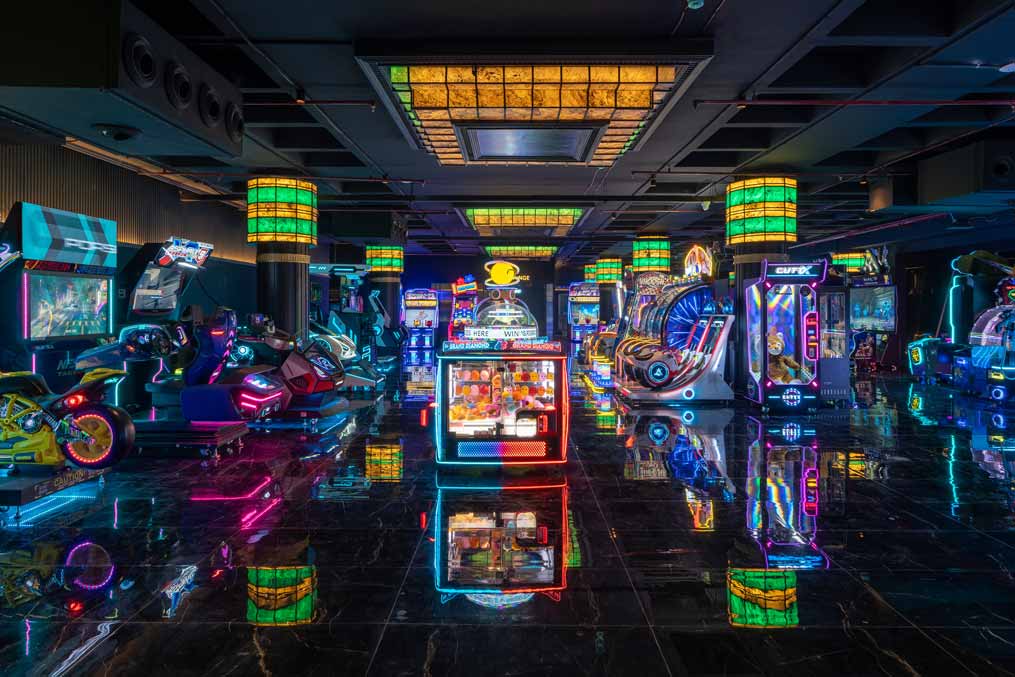
When you walk into any The Game Palacio location, you feel it immediately. The energy. The excitement. The sense that something fun is about to happen.
Our Pitampura location at R-Cube Monad Mall is a perfect example. We designed it as a “family-first” space. That means everyone feels welcome. Kids can play safely. Parents can relax. Friends can compete.
Our Ansal Plaza outlet in South Delhi takes things even further. We combined the latest entertainment technology with gourmet food and luxury design. The bowling lanes are special. They are made from premium Hungarian pinewood with black and gold plating. You can bowl in style while a butler brings you food and drinks.
We have over 30 immersive experiences at this location alone. You can play arcade icons like PAC-MAN, the same game that started it all back in 1980. Then you can jump into cutting-edge VR games like Asphalt 9 VR or Space Coaster. You travel from retro to future in seconds.
This is what we do at The Game Palacio. We build bridges between generations. Grandparents can show grandchildren the games they played. Kids can show grandparents the games they love now. Everyone finds something to enjoy.
Classic vs. Contemporary Games to Try Today
Let me share some recommendations for your next visit.
If you love classic arcade games:
Try PAC-MAN. It is over 40 years old and still impossible to put down. The rules are simple. Eat the dots. Avoid the ghosts. Eat a power pellet and turn the tables. But mastering it? That takes years.
Try the racing games too. Modern racing games at The Game Palacio like Need for Speed carry the spirit of those old driving games from the 1970s. The controls are intuitive. The action is fast. You do not need to read a manual. You just play.
If you love modern VR games:
You have to try Asphalt 9 VR. This is not just a game. It is an experience. You feel the speed. You lean into turns. You forget you are standing in a room because your brain believes you are on the road.
Space Coaster is another favorite. It combines a roller coaster ride with space combat. Your stomach drops as you dive through asteroid fields. You spin and loop while blasting enemies. It is thrilling in a way flat screens cannot match.
And do not forget bowling. Our bowling experience at The Game Palacio is something special. The lanes are beautiful. The scoring is automatic. The food service means you never have to leave your game.
Why Arcades Are Still Relevant in the Gaming World
Some people ask me this question. With games on phones, on computers, on consoles that fit in your pocket, why do we still need arcades?
The answer is simple. Arcades give us something screens cannot.
They give us presence.
When you play at home, you are alone or online. You might talk through a headset, but you cannot see the other person’s face. You cannot high-five after a win. You cannot tease each other after a loss.
At The Game Palacio, you can.
You can watch your friend try to beat your high score. You can cheer when they succeed. You can buy them a drink to celebrate. You can share a plate of truffle fries and talk about that amazing shot you just made.
Arcades also give us variety. At home, you play what you own. Maybe you have twenty games. Maybe fifty. At The Game Palacio, you have access to dozens of experiences. Racing one minute, shooting the next, bowling after that, VR to finish. You never get bored.
And arcades give us permission to be social. In a world where we spend so much time looking at screens alone, arcades pull us out. They put us in rooms with other people. They give us reasons to talk, to laugh, to compete, to connect.
That is why arcades survive. That is why they matter.
Future Trends in Arcade Entertainment
What comes next?
I think about this a lot. The history of arcade games teaches us that change is constant. What is popular today will be different tomorrow.
Virtual reality will keep getting better. The headsets will get lighter. The graphics will get sharper. The experiences will get more social. Soon, you might put on a headset and see your friends standing right next to you, even if they are actually across the room.
Mixed reality is coming too. Imagine playing air hockey on your real table, but with virtual goals and power-ups. Imagine bowling in a real alley, but with dragons flying overhead and explosions when you get a strike. The real world and the virtual world will blend together.
Arcades will become even more about food and drink. At The Game Palacio, we already see this. People come for the games, but they stay for the food. They book parties because they know everyone will find something to love. The future is not just gaming. It is dining. It is socializing. It is celebrating.
And corporate parties are a huge part of this trend. Companies are tired of boring events where people stand around making small talk. They want activities that build real connections. They want their teams to bond over shared challenges and shared victories. That is exactly what we provide.
Conclusion
The story of arcade games is still being written.
From those first penny machines in the early 1900s to the stunning VR experiences of today, one thing has never changed. We play because it is fun. We play because it brings us together. We play because for a few minutes, we forget our problems and just enjoy being alive.
At The Game Palacio, we are proud to be part of this story. We have locations across Delhi, with more coming to Bangalore, Hyderabad, and Mumbai soon. Each one is designed to create moments you will remember.
Whether you love classic arcade games or cutting-edge vr games, whether you want a fun family outing or a unique corporate party, whether you are celebrating something special or just escaping ordinary Tuesday, we have a place for you.
Come visit us. Drop a coin in a machine. Grab a joystick. Feel that old magic again.
The game is waiting.
FAQs
Q: What is the history of arcade games?
A: Arcade games began in the early 1900s with penny arcades and mechanical games. The first video arcade game was Computer Space in 1971, followed by Pong in 1972. The golden age arrived in the late 1970s and early 1980s with games like Space Invaders and Pac-Man. Today, modern arcades like The Game Palacio offer everything from classic games to VR experiences.
Q: What classic arcade games can I play at The Game Palacio?
A: At The Game Palacio, you can play arcade icons like PAC-MAN and racing games like Need for Speed. Our locations feature a mix of retro favorites and modern experiences, so everyone finds something they love.
Q: Does The Game Palacio have VR games?
A: Yes! We offer cutting-edge VR games including Asphalt 9 VR and Space Coaster. These immersive experiences let you step inside the game and interact with virtual worlds in ways flat screens cannot match.
Q: Can I host a corporate party at The Game Palacio?
A: Absolutely. We specialize in unique corporate party ideas with food, drinks, and gaming. Our team can create custom packages with tailored menus, beverage selections, and exclusive access to our gaming areas. It is the perfect way to boost team morale and foster real connections.
Q: Where are The Game Palacio locations?
A: We currently have multiple locations in Delhi, including Pitampura at R-Cube Monad Mall and South Delhi at Ansal Plaza. We are expanding soon to Bangalore, Hyderabad, and Mumbai, with more cities coming.
Q: Is The Game Palacio family-friendly?
A: Yes, absolutely. We design all our spaces as “family-first” environments. Kids can play safely, parents can relax, and everyone can enjoy the food, drinks, and games together.
Q: What makes The Game Palacio different from other game zones?
A: We combine premium entertainment with exceptional dining and luxury design. Our bowling lanes feature black and gold plating and butler service. Our culinary team creates gourmet dishes alongside classic favorites. We are not just a game zone. We are an entertainment hub where every visit feels special.
Q: Do I need to book in advance?
A: We recommend booking in advance, especially for groups and weekends. This ensures we can give you the best possible experience. You can contact your local The Game Palacio directly to make reservations.