What Makes the Pac-Man Arcade Game a Timeless Classic?
Some games come and go. You play them for a week. Then you forget them.
Other games stay with you forever.
Pac-Man is one of those games.
If you grew up in the 80s or 90s, you know this yellow character. You remember the maze. The dots. The ghosts. The simple joy of eating a power pellet and chasing those four colorful troublemakers.
But here is the surprising thing. Kids today love Pac-Man too.
My friend brought his 10-year-old son to The Game Palacio last month. The boy had never played Pac-Man before. He only knew modern games with fancy graphics and complex controls.
I showed him our Pac-Man arcade game. He was confused at first. “That’s it?” he asked. “Just a yellow circle eating dots?”
I said, “Try it.”
He played one round. Then another. Then another. An hour later, his father had to pull him away.
“What do you think?” I asked.
The boy smiled. “It’s hard. But I can’t stop trying.”
That is the magic of Pac-Man. Simple rules. Deep challenge. Endless fun.
Let us explore why this classic game has survived for over 40 years. And why you should play it at The Game Palacio.
The Origins of Pac-Man: A Revolution in Gaming
The year was 1980. Arcade gaming was young. Most games were about space. Shoot aliens. Destroy enemies. War and violence.
Then a young Japanese designer named Toru Iwatani had a different idea.
He wanted to make a game for everyone. Not just young boys. He wanted women and couples to play too. He wanted a game about eating, not fighting.
His inspiration? A pizza with a missing slice.
That missing slice became the mouth of Pac-Man. The yellow color was chosen because it was bright and happy. The ghosts were given personalities. Red was “Shadow.” Pink was “Speedy.” Blue was “Bashful.” Orange was “Pokey.”
The game was an instant hit in Japan. Then it came to America.
Within two years, people had spent over 1 billion dollars on Pac-Man. That was an unbelievable number in 1982. The game was everywhere. On t-shirts. On lunchboxes. On cereal boxes. On a hit song called “Pac-Man Fever.”
Pac-Man did not just become popular. It became a cultural phenomenon.
And here is the thing. You can still play the original version today. Not on a computer emulator. Not on a phone screen. The real arcade cabinet with the real joystick. You can find it at The Game Palacio, right next to our other arcade games.
Timeless Gameplay: Simple Yet Fun
What makes Pac-Man so good? The answer is simple.
It is easy to learn but hard to master.
Here are the rules. Move Pac-Man through the maze. Eat all the dots. Avoid the ghosts. Eat a power pellet to turn the ghosts blue. Then eat the ghosts for bonus points.
That is it. Four sentences. A child can learn in thirty seconds.
But mastering the game? That takes years.
Each ghost has a unique movement pattern. Learning these patterns is like learning a dance. Expert players can clear the first few levels with their eyes closed.
The game also gets harder as you progress. The ghosts move faster. The power pellets last shorter. The challenge increases.
This balance is perfect. Beginners feel good when they clear the first level. Experts feel challenged on level 20 and beyond.
Many modern games forget this lesson. They have complex controls and confusing menus. Pac-Man has one joystick. That is all.
At The Game Palacio, our entertainment hub celebrates this simplicity. We have many arcade games. But Pac-Man remains a favorite. Parents teach their children. Children challenge their parents. Everyone has fun.
The Psychology Behind the Popularity
Why do we love eating dots and running from ghosts?
Psychologists have studied this question. Their answers are fascinating.
First, Pac-Man gives us clear goals. Eat the dots. Avoid the ghosts. You always know what to do. This clarity reduces stress and creates focus.
Second, the game provides instant feedback. Eat a dot. Hear a sound. Score goes up. Your brain releases a tiny bit of dopamine. You feel good. You want more.
Third, the power pellet creates a wonderful emotional swing. You go from being scared to being powerful. The hunter becomes the hunted. Eating a blue ghost is one of the most satisfying feelings in arcade gaming.
Fourth, the game has no real ending. You can always try to beat your high score. You can always do better. This “infinite game” design keeps people coming back for decades.
I see this psychology in action every day at The Game Palacio.
A father walks in with his teenage daughter. She rolls her eyes at the “old” games. He plays a round of Pac-Man. She watches. She gets curious. She asks to try.
Next thing you know, they are competing. “I got to level 5.” “Oh yeah? Watch this.”
That is not just a game. That is connection. That is bonding. That is the power of classic games.
Pac-Man in Modern Pop Culture
Most games from 1980 are forgotten. Buried in digital graveyards. Only remembered by hardcore collectors.
Pac-Man is different. Pac-Man is everywhere.
The character appears in movies like “Pixels” and “Wreck-It Ralph.” There are Pac-Man cartoons from the 80s and new animated series today. Google made a playable Pac-Man doodle that millions enjoyed.
The design is iconic. That yellow circle with the missing slice. Even people who have never played the game recognize Pac-Man.
In 2015, the Pac-Man game was added to the World Video Game Hall of Fame. It was one of the first inductees. Alongside games like Super Mario Bros. and Doom.
That is the company Pac-Man keeps. The best of the best.
At The Game Palacio, we believe in preserving this history. Our game zone features classic cabinets alongside modern games. We want young players to know where modern gaming came from.
When you play the original Pac-Man on original hardware, you are touching history. The joystick you hold is the same design from 1980. The screen shows the same pixels. The sounds are the same beeps and boops.
It is a time machine. And it is waiting for you.
Must Try: Curated Arcade Experience at The Game Palacio
Reading about Pac-Man is fun. Playing Pac-Man is better.
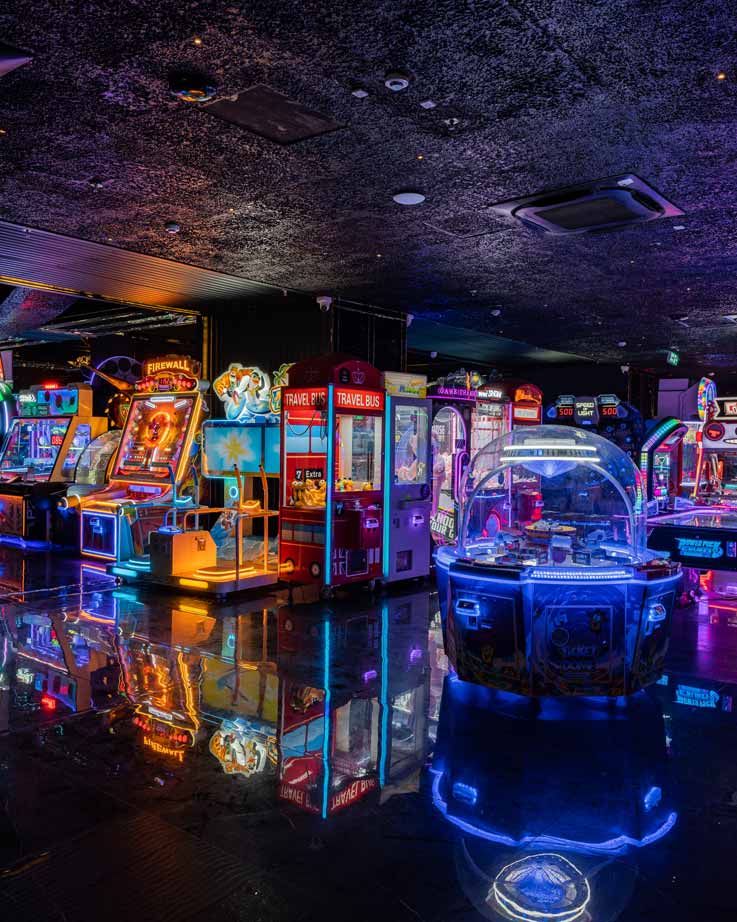
At The Game Palacio, we have created a curated arcade experience for our guests. Our collection includes Pac-Man and many other arcade games from the golden age.
But we are not just a museum. We are a living, breathing entertainment hub.
You can play Pac-Man for twenty minutes. Then challenge your friend to a racing game. Then try our bowling alley. Then eat some delicious food and beverages from our multicuisine restaurant.
We have modern attractions too. VR games that put you inside the action. Trampolines for active fun. Party spaces for celebrations.
The point is this. The Game Palacio is a place where old and new live together. Where parents and children can both find joy. Where nostalgia meets novelty.
For those planning events, we also offer unique corporate party ideas with food, drinks & gaming. Imagine your team bonding over a friendly Pac-Man competition. Followed by bowling. Followed by a great meal.
That is a party people will remember.
Conclusion
Pac-Man is not just a game. It is a piece of our shared culture.
It taught us that games could be about joy, not just conflict. It showed us that simple ideas, executed well, can last forever. It gave generations of families a reason to gather around a glowing screen and smile.
Forty years later, the yellow hero still chases dots. The ghosts still chase him. And we still cannot look away.
Come to The Game Palacio. Play the Pac-Man arcade game. Feel the same joy that people felt in 1980.
Then play something new. Eat something delicious. Laugh with your family or friends.
That is what we offer. That is who we are.
See you at The Game Palacio. Waka waka.
Frequently Asked Questions
Q1: Is Pac-Man still popular with younger generations?
Yes, surprisingly so. While young players grew up with modern graphics, many are drawn to the simple challenge of classic games like Pac-Man. At The Game Palacio, we regularly see teenagers and children spending hours on our Pac-Man arcade game. The gameplay is timeless.
Q2: What is the highest possible score in Pac-Man?
The perfect Pac-Man score is 3,333,360 points. This requires eating every dot, every fruit, and every ghost on every level without dying. Only a handful of players have ever achieved this. Most players consider a score of 100,000 to be excellent.
Q3: Do the ghosts have names and personalities?
Yes. The red ghost is Blinky (Shadow). The pink ghost is Pinky (Speedy). The blue ghost is Inky (Bashful). The orange ghost is Clyde (Pokey). Each ghost has a unique movement pattern. Learning these patterns is the key to high scores.
Q4: Where can I play an original Pac-Man arcade machine today?
Original machines are rare but can be found at dedicated entertainment hub locations. The Game Palacio maintains a well-kept original Pac-Man cabinet as part of our arcade games collection. Come visit us to experience the game as it was meant to be played.
Q5: How does Pac-Man compare to modern arcade games?
Modern arcade games often have complex controls, detailed graphics, and long tutorials. Pac-Man has one joystick and four rules. Yet the challenge is just as deep. Many players find the simplicity refreshing after playing complicated modern games.
Q6: Can Pac-Man help with brain health?
Studies suggest that playing classic games like Pac-Man can improve reaction time, pattern recognition, and strategic thinking. The game requires constant decision-making and spatial awareness. It is entertainment that also exercises your brain.
Q7: Does The Game Palacio host Pac-Man tournaments?
Yes. The Game Palacio regularly hosts casual and competitive gaming events. Follow our social media or visit our website to learn about upcoming tournaments for Pac-Man and other arcade games. Corporate groups can also request private tournaments as part of our event packages.